Praying like an Adult

Where did we get the idea that God is a divine vending machine? We put in a prayer and get what we want from God. I have heard this sentiment thousands of times, including from myself.

We think if the Vending Machine God doesn’t give us what we want then we choose not to believe in the God we created for ourselves. However that God doesn’t sound like a transcendent, omnipotent, omniscient being. That god is more like an over-indulgent parent with poor boundaries.

But we are praying for important things, like health, healing and peace in the world. Somehow wiping out suffering has never been a constant of human experience and that shows no sign of stopping. Sadly.

If our childish prayers aren’t about getting what we want it is about what God needs us to do, another self-important idea. I remember praying fervently as a child (and by fervently I mean eyes squeezed shut tight enough to produce a headache and perfectly pointed prayer hands to be sure the prayer reaches heaven) and said, “God I’ll do anything you need me to do but please don’t make go to Africa because I am scared of snakes and I saw the food those missionaries ate. I’ll starve to death so I can’t help you anymore.”

As I’ve grown over the years my prayers have turned less transactional and more intimate. It is usually not about getting things or doing things but about being aware of the presence of God and sharing my ideas, feelings, concerns and observations.

Prayers may be something like, “I wonder what You had in mind with that situation?” Or “ What are Your thoughts about this?”

My most frequent prayer is “………” which translated means “I don’t have words for this, I have feelings I cannot fully understand. You and I are together in this.”

Paradoxically, praying like an adult can bring us full circle back to a pre-verbal place wherein we can just be with God, sometimes still asking for things. And like any child with a wise parent sometimes getting what we want and sometimes not, but always getting a relationship.

X

Gratitude

Gratitude is the sign of noble souls. Aesop

Rejoice always, pray continually, give thanks in all circumstances; for this is God’s will for you in Christ Jesus. I Thessalonians 5:16-18

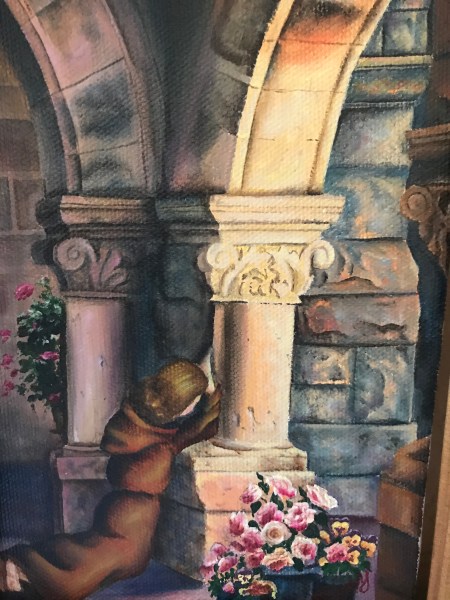
The above painting was inspired by gratitude around having a birth defect that had plagued me for years and fixed through surgery. Six years later I am grateful each morning that I walk without pain. This is my version of an often told story of gratitude.

One version is told about a runaway Greek slave who pulls the thorn from the lion’s paw. Later the slave was imprisoned and sent to Rome to be lunch for a lion. The creature who was to make a meal out of him turned out to be the lion he had helped. The lion showed his gratitude by not eating him. The slave was freed and traveled with the lion and the two became local celebrities.

This story has been told in different ways over the centuries but the idea of an unlikely friendship of opposites forged from gratitude remains a consistent theme. And the relief of suffering seems to be a common backdrop to gratitude.

While we generally avoid suffering somehow it comes to us all in some form. Maybe one of the meanings we can extract from suffering is to be grateful for those who help us through it. Or we can be thankful when it stops. It seems that some of the least grateful people are some of those who have not yet suffered.

Gratitude, which comes from the Latin word gratea, which means grace, graciousness or gratefulness, is a necessary component of emotional and spiritual maturity.

When we focus on gratitude we are appreciating what is good in our lives instead of focusing on what is deficient. In addition, we come closer to the source of our blessing which for believers always includes God.

Benefits of gratitude are many, including more and deeper positive emotions, greater happiness, better capacity to deal with adversity, better work and personal relationships, fewer doctor visits and overall better health.

However, eternal benefits of gratitude are a deeper bond with God. It can change our attitude from resentment and anger about deprivation to peace and joy. Suffering can be beautifully framed by gratitude around the kindness and good things that surround the pain. God allows suffering but also wants us to look at the entire situation. My deformation and healing experience has been an important shared experience between me and my God, one of my many spiritual treasures.

A Lonely Christmas

But Jesus often withdrew to lonely places and prayed. Luke 5:16 (NIV)

Be still and know that I am God. Psalm 46:10

Lonely is a frequently mentioned word in the therapy room when referring to Christmas, and especially this year, as many are separated from loved ones due to the pandemic. Depression and anxiety, the unwelcome twins who tend to visit around the holidays are extra obnoxious guests this year. The loss of community and family celebrations this year, as well as ongoing isolation, loss and fear is widespread. This has caused me to ponder what solitude and even loneliness can do to deepen our experience of God.

The pictures my mind paints to match the profound moments where human and God meet seem to be solitary events. The Annunciation, Moses on Mt. Sinai, Elijah in the cave, Jesus in the desert, and John the Baptist in the wilderness are just a few of the people who had powerful encounters with God while alone. In addition, many of the saints throughout history had life changing experiences while either alone or lonely. Even the events surrounding the Nativity seem to take place in remote, lonely places–fields and stables.

It seems that being alone removes our distractions from God, if we allow it. Humans are adept at distracting themselves away from painful or difficult feelings, it’s both a survival skill and a block to growth. However, it is loneliness, suffering and even pleasant solitude that pushes open a space in our souls for God to enter in powerful ways that are transformative. While we are alone, maybe we can set a space for God to join us, and this Guest will bring us a gift of joy and peace that our distractions would never allow us to have.

Curiosity

The world will never starve for want of wonders; but only for want to wonder.

G.K. Chesterton

A lack of curiosity is a form of suffering. We are created in the image of God, with the personality traits God possesses. This means that humans, in our unwounded state, are naturally curious. We observe this in babies and small children. They begin by looking, then licking and exploring by mouth, and touching whatever is interesting. We can continue to do more mature forms of exploration all of our lives if curiosity is not disowned.

Curiosity connects us with God. But curiosity can go underground if we experience trauma. A person cannot stop and explore if something deadly is threatening. We can also disown our natural sense of wonder if we are shamed, scolded or devalued for being curious, especially if this happens early in life. We can quell our sense of wonder if we fear we will be rejected if we aren’t like others. We can choose to conform and be accepted or take a risk of rejection and find vistas of abundant life we didn’t know were possible.

If our natural state of wonder is not present in our relationship with God, it is impoverished and lacks many dimensions. Our prayer life is flat, and lacks the richness we can share with God if we bring our entire selves to Him. We miss out not only what we can bring to God, but also in what God has to show us and share with us in His perfect creativity. Most tragically, we have very limited awareness of God, since to really know God, we must seek Him, and curiosity drives the search.

As with most healing, we start by acknowledging the problem of a lack of imagination and ask God’s help in repairing our deadened curiosity. If we have trauma in our lives, getting therapy can help open the way for new and amazing ways of thinking, as well as healing the wounds that limit us and harm our growth.

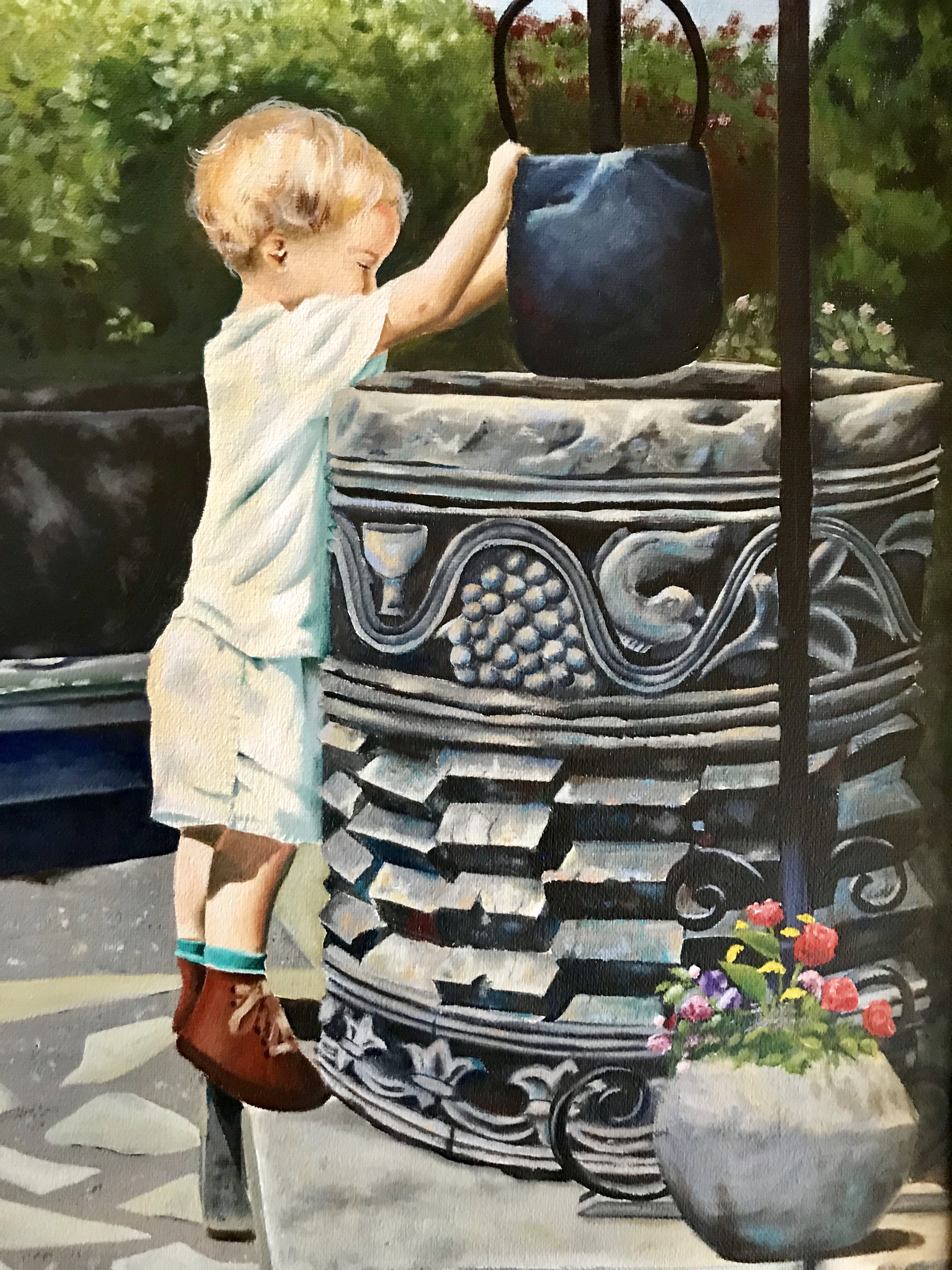
If we need an example to remind us what curiosity looks like, study how a small child goes through the day. Everything from the roundness of a pea, to how a car lock works, to a dog is worthy of examination and delight. Even their approach to God is full of innocence, trust and curiosity.

Jesus said, “Let the little children come to me, and do not hinder them, for the kingdom of God belongs to such as these. I tell you the truth, anyone who will not receive the kingdom of God like a child will never enter it.” Luke 18:16,17 (NIV). Like a child, let us be curious about God and find the joy that children know.

Mad at God

God is confusing and difficult to understand. Often we find ourselves very frustrated. How mad we get at God depends on what we expect of God. The more we expect the more angry we are when God doesn’t behave like we think God should act.

Underneath anger is usually hurt or fear. I hear people express anger at God several times a week in my professional work as a therapist but I have never yet heard someone say, “God hurt my feelings” or “I’m afraid of God and how God operates.” At least those are not the first sentiments expressed. The closest we come is to think God is sadistic or that there is no God at all since I don’t like the version of God that I think is operating the world.

God is, at the very least, confusing. It’s difficult to stay with the feeling of confusion. We tend to move into judgement then anger when things don’t make sense to us. But maybe staying for awhile with the confusion and frustration can lead us to deeper places within ourselves and even to a deeper spiritual life.

In GK Chesterton’s novel, The Man who was Thursday, which was published in 1908, the author beautifully depicts this struggle and the strong relationship that can unfold as a result. The character Sunday engages in puzzling and frustrating behavior as he leads his followers on what seems like a wild goose chase. As he is the leader and a type of God character, even the frustration the other characters feel and the time spent trying to make sense of Sunday’s behavior bind them more closely to him.

Mr. Sunday, like God defies every attempt to neatly categorize him. Because of this, his followers must think in totally new ways, which opens the way for a more meaningful and complex relationship. God is good and gives us good things much of the time. But if that is all we want God for He is not much more than a Divine vending machine. God frustrates us, puzzles us, and allows us to suffer to push us beyond the parent giver/infant receiver relationship into a deeper, more life giving relationship between God and human.

Suffering—Alive in Pain

Ponder this: The Lord your God is with you, He is mighty to save. He will quiet you with His love, He will rejoice over you with His singing. Zephaniah 3:17 (NIV)

And this: Praise be to the God and Father of all compassion and the God of all comfort, who comforts us in all our troubles, so that we can comfort those in any trouble with the comfort we ourselves have received from God. For just as the sufferings of Christ flow over into our lives, so also through Christ our comfort overflows. 2 Corinthians 1:3-5 (NIV)

Suffering is not the opposite of living. In fact, anyone who has suffered greatly knows that we are very alive when we feel the excruciating pain of suffering. Suffering, seeking God, demanding answers, anger—these are the signs of life, even abundant life. The opposite of this is emotional deadness, emptiness, apathy, lack of curiosity and lack of seeking. This is not abundant life, and a way to avoid pain.

I have pondered the meaning of suffering probably more than I have any other concept in life, and talked to God about it for as long as I can remember. It wasn’t just an intellectual exercise. Angst can turn a person into a philosopher. In my life of work I explore the meaning of suffering with others daily. Even those who do not believe bring God onto conversations about suffering. Somehow suffering binds us to God.

When we suffer we do not feel powerful. Suffering takes us to places inside ourselves we would never choose to go otherwise. It can humble us, and help us see our small place in the universe. We have to mentally wander outside ourselves and our own lives and look at the rest of the world. Then we find we are not alone in our pain.

Frequently people will feel that no one’s suffering is as bad as theirs, or that theirs is not as bad as others. Often both ideas are a defense. Either I am special and get my sense of value from my unfortunate circumstance, or I give myself a pep talk to deny the reality of my pain. Auchwitz survivor and psychologist Victor Frankl said, “Never compare suffering. Everyone has their own Auchwitz.” If we just accept that suffering comes to us at some time in our life, we can learn the lesson it has to teach us.

While none of us would sign up for suffering, some of us—even those who have suffered greatly would not trade what we learned from the experience after it is over. Since every experience we have can offer an awareness of a different facet of God. In pain we get to know God in ways that it would be impossible to know Him otherwise. God can be for us what we have not yet needed or allowed God to be prior to our trials.