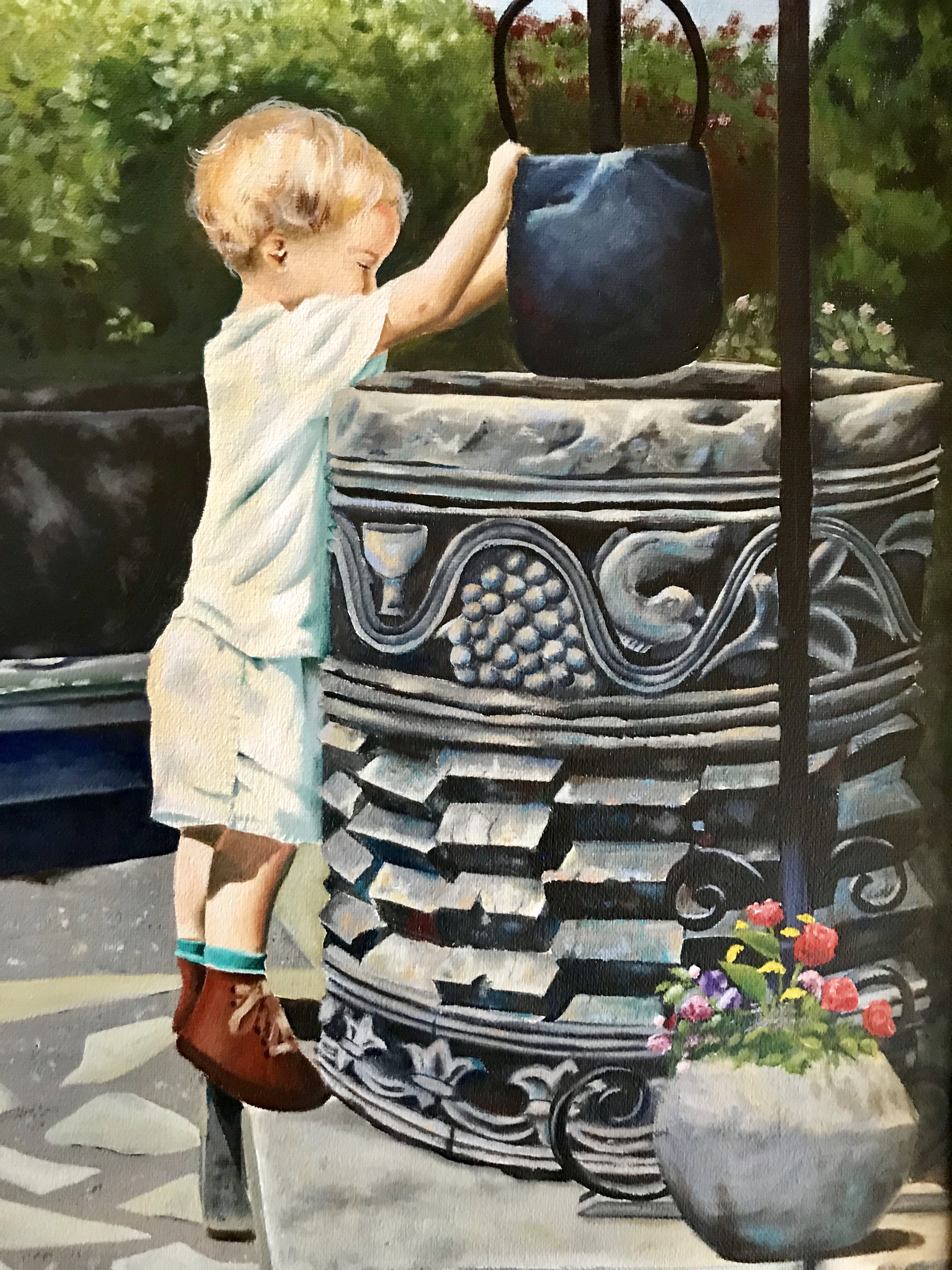
Praying like an Adult

Where did we get the idea that God is a divine vending machine? We put in a prayer and get what we want from God. I have heard this sentiment thousands of times, including from myself.

We think if the Vending Machine God doesn’t give us what we want then we choose not to believe in the God we created for ourselves. However that God doesn’t sound like a transcendent, omnipotent, omniscient being. That god is more like an over-indulgent parent with poor boundaries.

But we are praying for important things, like health, healing and peace in the world. Somehow wiping out suffering has never been a constant of human experience and that shows no sign of stopping. Sadly.

If our childish prayers aren’t about getting what we want it is about what God needs us to do, another self-important idea. I remember praying fervently as a child (and by fervently I mean eyes squeezed shut tight enough to produce a headache and perfectly pointed prayer hands to be sure the prayer reaches heaven) and said, “God I’ll do anything you need me to do but please don’t make go to Africa because I am scared of snakes and I saw the food those missionaries ate. I’ll starve to death so I can’t help you anymore.”

As I’ve grown over the years my prayers have turned less transactional and more intimate. It is usually not about getting things or doing things but about being aware of the presence of God and sharing my ideas, feelings, concerns and observations.

Prayers may be something like, “I wonder what You had in mind with that situation?” Or “ What are Your thoughts about this?”

My most frequent prayer is “………” which translated means “I don’t have words for this, I have feelings I cannot fully understand. You and I are together in this.”

Paradoxically, praying like an adult can bring us full circle back to a pre-verbal place wherein we can just be with God, sometimes still asking for things. And like any child with a wise parent sometimes getting what we want and sometimes not, but always getting a relationship.

X

Gratitude

Gratitude is the sign of noble souls. Aesop

Rejoice always, pray continually, give thanks in all circumstances; for this is God’s will for you in Christ Jesus. I Thessalonians 5:16-18

The above painting was inspired by gratitude around having a birth defect that had plagued me for years and fixed through surgery. Six years later I am grateful each morning that I walk without pain. This is my version of an often told story of gratitude.

One version is told about a runaway Greek slave who pulls the thorn from the lion’s paw. Later the slave was imprisoned and sent to Rome to be lunch for a lion. The creature who was to make a meal out of him turned out to be the lion he had helped. The lion showed his gratitude by not eating him. The slave was freed and traveled with the lion and the two became local celebrities.

This story has been told in different ways over the centuries but the idea of an unlikely friendship of opposites forged from gratitude remains a consistent theme. And the relief of suffering seems to be a common backdrop to gratitude.

While we generally avoid suffering somehow it comes to us all in some form. Maybe one of the meanings we can extract from suffering is to be grateful for those who help us through it. Or we can be thankful when it stops. It seems that some of the least grateful people are some of those who have not yet suffered.

Gratitude, which comes from the Latin word gratea, which means grace, graciousness or gratefulness, is a necessary component of emotional and spiritual maturity.

When we focus on gratitude we are appreciating what is good in our lives instead of focusing on what is deficient. In addition, we come closer to the source of our blessing which for believers always includes God.

Benefits of gratitude are many, including more and deeper positive emotions, greater happiness, better capacity to deal with adversity, better work and personal relationships, fewer doctor visits and overall better health.

However, eternal benefits of gratitude are a deeper bond with God. It can change our attitude from resentment and anger about deprivation to peace and joy. Suffering can be beautifully framed by gratitude around the kindness and good things that surround the pain. God allows suffering but also wants us to look at the entire situation. My deformation and healing experience has been an important shared experience between me and my God, one of my many spiritual treasures.

A Lonely Christmas

But Jesus often withdrew to lonely places and prayed. Luke 5:16 (NIV)

Be still and know that I am God. Psalm 46:10

Lonely is a frequently mentioned word in the therapy room when referring to Christmas, and especially this year, as many are separated from loved ones due to the pandemic. Depression and anxiety, the unwelcome twins who tend to visit around the holidays are extra obnoxious guests this year. The loss of community and family celebrations this year, as well as ongoing isolation, loss and fear is widespread. This has caused me to ponder what solitude and even loneliness can do to deepen our experience of God.

The pictures my mind paints to match the profound moments where human and God meet seem to be solitary events. The Annunciation, Moses on Mt. Sinai, Elijah in the cave, Jesus in the desert, and John the Baptist in the wilderness are just a few of the people who had powerful encounters with God while alone. In addition, many of the saints throughout history had life changing experiences while either alone or lonely. Even the events surrounding the Nativity seem to take place in remote, lonely places–fields and stables.

It seems that being alone removes our distractions from God, if we allow it. Humans are adept at distracting themselves away from painful or difficult feelings, it’s both a survival skill and a block to growth. However, it is loneliness, suffering and even pleasant solitude that pushes open a space in our souls for God to enter in powerful ways that are transformative. While we are alone, maybe we can set a space for God to join us, and this Guest will bring us a gift of joy and peace that our distractions would never allow us to have.

The Light that Came into the World

Light has come into the world. John 3:19a (NIV)

As a therapist I frequently see that the darkness of winter often matches the darkness of thought that can visit during the Christmas season. Many hours are spent in the therapy office every year exploring loneliness, sadness, depression, anxiety, grief and disappointment. While these experiences are real and legitimate, they can be intensified by an over focus on other people’s choices and behavior. The over- emphasis on family during the holidays is a huge factor in Christmas misery.

It is as if our hearts are silently waiting for a quiet but spectacular event. When we put that expectation on Santa, or family, friends or parties we end up with a sense of hollowness, even if these things are good. There is a divine expectation that can only be met by the appearance of the divine.

I think of the most sacred Christmas experiences in my life and they were all between God and I. Sometimes they occurred as I watched snow fall on a deepening night sky and was reminded of the silence that shrouded the miracle of God coming to the world in a humble form. Sometimes I am sitting in the candlelight of a worship service and imagining shepherds and angels and the feelings they had that something spectacular has happened.

My heart leaps for joy when I ponder the mystery of numinous Light coming into the world in a smelly little stable. Meditating on this amazing event and its significance is creates such joy it helps us understand why whatever expectations about other things we might have or want for the holidays are a disappointment in comparison.

Love others but you might not Please Them

If I were still trying to please people, I would not be a servant of Christ.

Paul, Galatians 1:10

Love your neighbor as yourself.

Part of the verse Mark 12;31. Both NIV

These verses seem to make a strange pair. Can a person love someone else as much as themselves, but not feel compelled to please them? It can be difficult to love people who disapprove of us, judge us, or don’t love us back. But if we can love someone who is unlovely or unloving, we participate in a mystery with Christ who loves without love being returned. He loved so deeply he took on the sins of us all, to invite a relationship between God and human that would not have happened otherwise.

Jesus was the Son of God so he apparently could tolerate being despised and rejected by men, but how do we mortals handle rejection? We can do this by getting our need for approval from others out of the way. When we are young, we become civilized by learning from others what is the approved behavior. As we grow emotionally, and have permission to think for ourselves,we do not automatically defer to others to tell us what is correct. Freedom of thought begins with the magical question, “why?”. If we are lucky, we are allowed to ask this question, as it teaches us to reflect.

And if we learn to reflect, along our path of growth we learn that people are not always correct in their assessments. They are not objective. The approved behavior may merely be convenient for them, or decreases their sense of guilt or anxiety. What if what they want is at odds with our spiritual life? What if they are disappointed and love us a little, or a lot less? How can we tell if we are giving others a place God should occupy? We know there is a problem if we are crushed by the disapproval of others, rather than merely disappointed.

I have noticed that we all want to be liked, and we all in our natural, un-defensive state, we value others and seek a positive response from them. If we don’t there is something deeply damaged in us, to the point we have dehumanized ourselves and others. I think that has something to do with the fact that we are all made in the image of God, and at some level we recognize it in others. You can see this when you begin to talk and behave differently when someone comes into the room. Whether it is a friend or a stranger, a certain amount of energy is expended, even just becoming aware of a presence.

Some people expect a lot more than that. Some only feel loved or valued if others agree with them. Since spiritual and psychological identical twins don’t exist, those who need exact mirroring are eventually disappointed. It is only a matter of time, and those who need total agreement will be disappointed and leave so faking agreement only delays the inevitable. The need for mirroring when we are adults is a wound, and it doesn’t heal the wound to trying to copy the wounded person.

Maybe we are one of these wounded, and only feel temporarily loved when someone totally “gets” us, which means understands and often means agrees with us. Not only do we often let other play God by judging us, we may demand they play God by understanding us completely. (Note: Marital advice–don’t look for complete understanding in a marriage. This expectation is too much for a marriage to bear. Marriage is a mystery that unfolds over many years.) This is God’s job, to completely “get” us.

One of God’s great love notes to us in Psalm 139 says that even before a thought is in our head God knows it. God know why we had it, and how many times were had it before. God understands us way better than we understand ourselves.

The most amazing thing we can do is to love when we haven’t been loved, or are not loved. This is Divine. To love but also be true to our spiritual journey when it disappoints others also takes us to a deep and honest place where we can grow in amazing ways. And finally, when we long for something from another person, is that something that can really only be supplied by God? Check with God and see.

Trying to Look through God’s Eyes

For decades I have prayed that I could get glimpses of seeing the world through God’s eyes. I try to imagine what it is like to know every thought everyone is having at any given moment. I believe that must be both humorous and sometimes heartbreaking for God. I am in awe at the many things God can hold in His mind at the same time.

From time to time I get to look at the world from a vantage point that stirs up my curiosity anew, as a passenger in a small airplane. I am overwhelmed, not only by all the buttons and dials, but by the time of worship that ensues.

Recently I asked the pilot if he believed in God and he said yes. I asked if he felt closer to God when he flew and he said yes. He said he felt closer to God and that he might be sharing in one of the many ways God sees the world.

As I look down onto homes, forests and buildings, my challenges shrink as I imagine God knowing every detail of every heart in every place that is thousands of feet below. God know every joy, every fear, every heartbreak. God feels each feeling along with each person, as well as His own feelings about our feelings. The amazing capacity of God is so vast it hurts my brain to think about this.

One of the many values of these thoughts is that our thoughts are not the most important things happening in the universe but part of a greater pattern of all our lives together that are part of God’s constant attention.

Holy Ground

God said, “Do not come any closer. Take off your sandals, for the place you are standing is holy ground.” Exodus 3:5. NIV

In the never ending parade of thoughts that present themselves to us, themes reappear. A lifelong theme for me has been the idea of holy ground. My first encounter with this was as a small child when encountering an illustration of Moses and the burning bush.

As a pre-literate, pre-focused pre-schooler, church services were a challenge. After my under pew examination, noting the temperature of the floor with my cheek, drawing the monsters I saw in my closet the previous night and examining my dad’s fingernails, I would look through the pictures in my mom’s Bible.

The picture that captivated me (the way I saw it was probably nothing like the actual picture) was Moses with a curly mane of black and gray hair and a scruffy beard. He looked both curious and scared, clutching his staff, standing with legs spread and braced for something big. The ground beneath him fascinated me more. It was the very top of the mountain, rough with a pink glow that looked like rose quartz with a roaring fire beneath. I imagined it both hot and cool at the same time. I didn’t know it at the time, but this was my first encounter with awe.

My childhood walks through a nearby woods consisted of scouting for burning bushes. I never found any but gradually I realized that all I had to do was visualize the picture and a sense of sacred awe flooded my mind. God was big and mysterious. Did God create holy ground in my soul?

As I sit with clients in my office, and a life changing insight emerges it feels like an epiphany–an appearance of God. The room feels like holy space. Human meets God.

All my life I have looked for spaces of God in high concentrations. As the men on the road to Emmaus declared, “Were not our hearts burning within us?”, my burning heart seems to be a Geiger Counter indicating holy ground, whether in the inner or the outer world.

Abundant Life in God?

You fill me with joy in your presence. David, Psalm 16:11

To miss joy is to miss all. Robert Louis Stevenson, 1887

I have come that they may have life, and have it to the full.

Jesus, John 10:10

What is a life to the full, or an abundant life, as some Bible translations say? Is it an intellectual idea or a way of existing? Is it for believers now or only after this life? I have an idea it can be all of that. There is something innate that makes us long for abundant life in God, now and to come. We do not just want to know about God. We are wired to seek a relationship with God.

Humans are wired for relationship from birth. Babies come out ready to attach—longing to be enfolded in the love and warmth of a parent. We never lose that longing, first for our parents, then others, and ultimately God.

We long to lose ourselves in the divinity of another. Unfortunately, most of the time we project God’s divinity onto another, which can be euphoric for awhile and often ends in heartbreak. But if we can imagine the most extreme joy and attraction we have had for another human, then put that longing to God—that’s only the beginning.

Many of us cannot imagine a God that is amazing. We often see God as a distant, clueless, grumpy, shifty, disengaged, old man. When life is tough we can see God as out of touch, harsh and elusive.

What if we watch for God to show up in the not so traditional and expected ways? God could be in a burning bush as Moses experienced, or a still, small voice like Elijah heard. God could inhabit a sunset, a ladybug, a baby or an old man. How about God being in a thought, a feeling, or an idea? If we can see God in all things and through all things as Colossians 1:17 suggests, we can experience abundant life in God daily.

Finding Facets of God

A facet is one detail of a many sided thing. In a diamond, the more facets, the more beautiful the stone.

I wonder how many of the facets of God I have seen. I wonder how many of the facets I have the capacity to see. Do different people touch different aspects of God? Have we as a group of believers from the beginning of human history until now only touched a few facets of this God we long to know? How can we increase our capacity to know more facets of God?

There is some evidence that blue is the most recent color that the human eye could see. Prior to that things that appear blue now were seen differently. Humans eyes have increased capacity to see colors so we can now see over a million different colors.

What if we can grow in our capacity to see more of God? Would a wider variety of experiences help us know different aspects of God? Have we even known the facets that are named in the Bible? Wonderful Counselor. Mighty to Save. A Still, Small Voice. I Am Who I Am (Everything I Am I Will Be to You). These are just a few of the facets of God saints in the Bible have experienced.

When we feel awe we can see the largeness and creativity of God. When we suffer it is possible to feel the nurturing comfort of God. When we are small or immature we experience God like a father or a mother. As we grow God may be more of a friend, adviser, or an invisible power in all things and through all things in addition to a parent.

So just like a diamond is more beautiful the more facets we see, the more sides of God we see the more we can know the beauty of God.

Curiosity

The world will never starve for want of wonders; but only for want to wonder.

G.K. Chesterton

A lack of curiosity is a form of suffering. We are created in the image of God, with the personality traits God possesses. This means that humans, in our unwounded state, are naturally curious. We observe this in babies and small children. They begin by looking, then licking and exploring by mouth, and touching whatever is interesting. We can continue to do more mature forms of exploration all of our lives if curiosity is not disowned.

Curiosity connects us with God. But curiosity can go underground if we experience trauma. A person cannot stop and explore if something deadly is threatening. We can also disown our natural sense of wonder if we are shamed, scolded or devalued for being curious, especially if this happens early in life. We can quell our sense of wonder if we fear we will be rejected if we aren’t like others. We can choose to conform and be accepted or take a risk of rejection and find vistas of abundant life we didn’t know were possible.

If our natural state of wonder is not present in our relationship with God, it is impoverished and lacks many dimensions. Our prayer life is flat, and lacks the richness we can share with God if we bring our entire selves to Him. We miss out not only what we can bring to God, but also in what God has to show us and share with us in His perfect creativity. Most tragically, we have very limited awareness of God, since to really know God, we must seek Him, and curiosity drives the search.

As with most healing, we start by acknowledging the problem of a lack of imagination and ask God’s help in repairing our deadened curiosity. If we have trauma in our lives, getting therapy can help open the way for new and amazing ways of thinking, as well as healing the wounds that limit us and harm our growth.

If we need an example to remind us what curiosity looks like, study how a small child goes through the day. Everything from the roundness of a pea, to how a car lock works, to a dog is worthy of examination and delight. Even their approach to God is full of innocence, trust and curiosity.

Jesus said, “Let the little children come to me, and do not hinder them, for the kingdom of God belongs to such as these. I tell you the truth, anyone who will not receive the kingdom of God like a child will never enter it.” Luke 18:16,17 (NIV). Like a child, let us be curious about God and find the joy that children know.