Mad at God

God is confusing and difficult to understand. Often we find ourselves very frustrated. How mad we get at God depends on what we expect of God. The more we expect the more angry we are when God doesn’t behave like we think God should act.

Underneath anger is usually hurt or fear. I hear people express anger at God several times a week in my professional work as a therapist but I have never yet heard someone say, “God hurt my feelings” or “I’m afraid of God and how God operates.” At least those are not the first sentiments expressed. The closest we come is to think God is sadistic or that there is no God at all since I don’t like the version of God that I think is operating the world.

God is, at the very least, confusing. It’s difficult to stay with the feeling of confusion. We tend to move into judgement then anger when things don’t make sense to us. But maybe staying for awhile with the confusion and frustration can lead us to deeper places within ourselves and even to a deeper spiritual life.

In GK Chesterton’s novel, The Man who was Thursday, which was published in 1908, the author beautifully depicts this struggle and the strong relationship that can unfold as a result. The character Sunday engages in puzzling and frustrating behavior as he leads his followers on what seems like a wild goose chase. As he is the leader and a type of God character, even the frustration the other characters feel and the time spent trying to make sense of Sunday’s behavior bind them more closely to him.

Mr. Sunday, like God defies every attempt to neatly categorize him. Because of this, his followers must think in totally new ways, which opens the way for a more meaningful and complex relationship. God is good and gives us good things much of the time. But if that is all we want God for He is not much more than a Divine vending machine. God frustrates us, puzzles us, and allows us to suffer to push us beyond the parent giver/infant receiver relationship into a deeper, more life giving relationship between God and human.
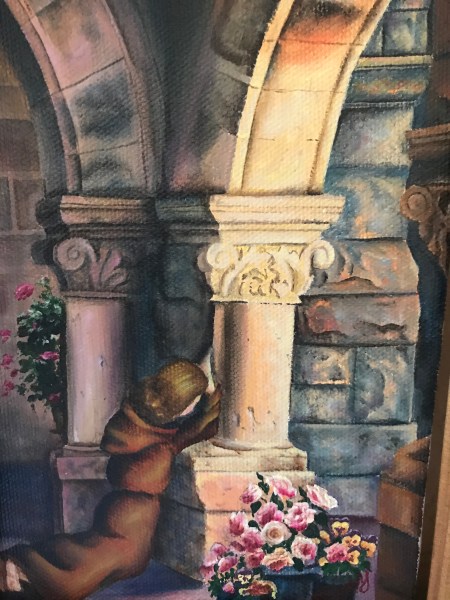

Suffering—Alive in Pain

Ponder this: The Lord your God is with you, He is mighty to save. He will quiet you with His love, He will rejoice over you with His singing. Zephaniah 3:17 (NIV)

And this: Praise be to the God and Father of all compassion and the God of all comfort, who comforts us in all our troubles, so that we can comfort those in any trouble with the comfort we ourselves have received from God. For just as the sufferings of Christ flow over into our lives, so also through Christ our comfort overflows. 2 Corinthians 1:3-5 (NIV)

Suffering is not the opposite of living. In fact, anyone who has suffered greatly knows that we are very alive when we feel the excruciating pain of suffering. Suffering, seeking God, demanding answers, anger—these are the signs of life, even abundant life. The opposite of this is emotional deadness, emptiness, apathy, lack of curiosity and lack of seeking. This is not abundant life, and a way to avoid pain.

I have pondered the meaning of suffering probably more than I have any other concept in life, and talked to God about it for as long as I can remember. It wasn’t just an intellectual exercise. Angst can turn a person into a philosopher. In my life of work I explore the meaning of suffering with others daily. Even those who do not believe bring God onto conversations about suffering. Somehow suffering binds us to God.

When we suffer we do not feel powerful. Suffering takes us to places inside ourselves we would never choose to go otherwise. It can humble us, and help us see our small place in the universe. We have to mentally wander outside ourselves and our own lives and look at the rest of the world. Then we find we are not alone in our pain.

Frequently people will feel that no one’s suffering is as bad as theirs, or that theirs is not as bad as others. Often both ideas are a defense. Either I am special and get my sense of value from my unfortunate circumstance, or I give myself a pep talk to deny the reality of my pain. Auchwitz survivor and psychologist Victor Frankl said, “Never compare suffering. Everyone has their own Auchwitz.” If we just accept that suffering comes to us at some time in our life, we can learn the lesson it has to teach us.

While none of us would sign up for suffering, some of us—even those who have suffered greatly would not trade what we learned from the experience after it is over. Since every experience we have can offer an awareness of a different facet of God. In pain we get to know God in ways that it would be impossible to know Him otherwise. God can be for us what we have not yet needed or allowed God to be prior to our trials.

The God We Cannot See

Some people will talk about their relationship with God as if God were a scolding, remote, impossible to please parent. God requires something that they can’t quite figure out but if they don’t they will not receive God’s goodness. These same folks will speak lovingly and enthusiastically about a lover, baseball, football, a rock star, movie star or some other unattainable person that evokes magical feelings in them. I hear tender attentiveness to the cherished object. I hear people experiencing something larger than themselves (even if they are agnostic). How often to people talk with this level of love and passion about God? How many people feel this adoration for God? I don’t know the answer to these questions but I am guessing it’s not enough.

People are made to worship and tend to be good worshippers of something. It begins when we are infants and totally dependent on our parents for life. They are all powerful and we are powerless. We are wired from birth to depend on someone far more powerful than we are. We we begin our journey in this world idealizing another. Even the agnostic Sigmund Freud realized this when in 1914 he wrote in A Schoolboy Psychology that our first template for God is our parents. When we are infants and toddlers we think of our parents as God, then soon after parents are not quite God but God-like. By about age five they are God’s assistants, maybe having a special hotline to God. When we are old enough to see our parents’ flaws we look for something to be the recipient of our need to to worship.

I know I projected God onto a human in those early years. Around age five, as a pee wee theologian, I believed that God worked as a clerk at our local supermarket. (That was before the movie “Oh God” came out but apparently someone else had the same idea about God’s involvement in the grocery business.) This man seemed so kind and gentle but I got suspicious when he said, “Hi Joe. How are you?” to my Dad, who somehow was in tight with God. This was a strange question for a God who already knew how we all were, my dad included. Also, I wondered why was God wearing glasses since he’s perfect. I concluded that it was a clever disguise to avoid exposing His undercover operation because even at age five I knew that God made us search hard for Him.

While all of us begin life thinking of God as a concrete person we can see, we are meant to use this only as a beginning place to know God as real. We are meant to emotionally and spiritually outgrow this need we have to make God something we can see, hear and hug. But unless we deliberately work at spiritual maturity, we do not grow. God seems disengaged and uncaring. Then we tend to project the passion meant for God onto a person, thing or experience on earth and miss the mysterious joy of relationship with an invisible God whose fingerprints are everywhere.

The Free Will Mystery that Compels me to God

As a curious four year old, laying on my back on the grass of my front yard, I tried to look as far into the sky as I could and see if  I could get a glimpse of God. I never saw the white bearded grandfatherly giant I looked for, no matter how hard I scanned and squinted. So I formulated my first theology.

 Rather than decide that God is not involved with humans, I decided that his fat fingers vanished when they hit the atmosphere of earth.  We were controlled by God but we thought we were acting of our own free will, and we were too dumb to know the difference.   This theology was heavily informed by my experience of playing with Barbie dolls. I figured that like me as the Master and Controller of my dolls, and they passively did whatever I dictated, and in the same way we were putty in God’s hands.

I longed for my dolls to respond in some way independent of my directives.  Maybe they would have a little party going on when I came back to my bedroom. Maybe they would dress themselves for once and save me the trouble. I wondered if God felt the same, and liked it when we acted of our own volition. So just to entertain God and show him I had a mind of my own I would periodically do things that were out of character, for me and for most people—things weirder than just eating paste, one of the more typical childhood weirdnesses. I would make up new words, or walk backwards or draw and name creatures that didn’t exist. I still don’t know how God felt about this but my family still calls me “weird”.

As I grew I realized my four year old questions are the same as those of the most educated theologians for centuries—the mystery of free will versus predestination.  I read passages in the  Bible that point toward God’s involvement in our will like Proverbs 21:1 (NIV), “in the Lord’s hand the King’s heart is a stream of water that he channels toward all who please him.” 

On the other hand. The Bible points out our free will, like in Galatians 5:13 (NIV) which says, ”you, my brothers and sisters, were called to be free. But do not use your freedom to indulge the flesh; rather serve one another humbly in love.” This implies we have choices and are responsible for the decisions we make.

So I still don’t know the answer to these questions despite a lifetime of research, college, seminary and the rough and sometimes delightful classroom of life. But I still lay on my lawn and look toward heaven trying to find God. This is a blog about my search for truth, wisdom and joy by relationship with God. I don’t have answers to my theological questions but I do know I have grown in love, joy and peace in God as I traverse my inner and outer life. I am writing this to invite you to ponder God in ways that may help you cope in times of suffering and to open yourselves to love, peace and immense joy.